Don’t Poke the Bear: Navigating Boundaries, Trauma, and Peace This Thanksgiving
Don’t Feed the Bears…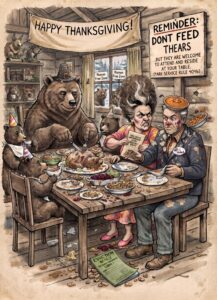
It’s funny how we give emotional qualities to things we don’t fully understand. Sometimes, we even assume everyone is kind and cuddly—until they turn into a wild, unpredictable bear.
Take bears, for example.
When a child is born, one of the first gifts they often receive is a teddy bear. Soft. Cuddly. Comforting. A symbol of safety and affection. There’s nothing wrong with that. Many of us hold on to our childhood bears for years because they remind us of simpler times. Mine was Tigger from Winnie the Pooh. Technically, he’s a tiger, not a bear—but the point is the same: something that seems simple and playful can be much more complex than it appears.
The real bear—or the real tiger—is a very different story.
In the wild, a bear’s main instinct isn’t to be cuddly. It’s to survive. When threatened, cornered, or provoked, a bear will defend itself. Wildlife experts offer simple advice: don’t feed the bear, and don’t poke the bear. Respect its nature, keep your distance, and understand its boundaries.
That was the inspiration behind my Hump Day image this past week.
As I thought about it, I realized the lesson applies to people, too.
Many of us carry invisible wounds. People living with anxiety, trauma, or complex PTSD often spend enormous energy managing emotions, memories, and triggers that others can’t see. Like bears, we all have protective instincts. When we feel threatened, misunderstood, or pushed beyond our limits, those defenses can rise to the surface.
The holidays have a way of testing those boundaries.
As Thanksgiving approaches, many of us are juggling much more than grocery lists and travel plans. Nearly every day brings another alarming headline, another crisis, or another reason to worry. Add family expectations, financial stress, difficult relationships, and old memories, and it can feel like the emotional volume has been turned all the way up.
For trauma survivors especially, the holidays can bring unexpected guests to the table. Sometimes those guests aren’t people. They’re memories, grief, anxiety, and unresolved conflict. They might also arrive as a relative who’s had too much to drink, a family member determined to debate every headline, or a well-meaning person who unknowingly presses on an old wound.
That’s where the lesson of the bear comes in.
Not every argument needs a response. Not every provocation deserves our attention. And we don’t have to accept every invitation to conflict.
Sometimes the healthiest choice is to recognize what’s happening and gently step away.
In my book, *The Saints Who Saved Me*, I return often to resilience, spirituality, healing, and hope. One lesson I keep learning is that strength doesn’t always mean fighting every battle. Sometimes, it means choosing peace instead of reacting.
In 1863, during the Civil War—one of the most painful periods in American history—Abraham Lincoln encouraged Americans to pause and give thanks despite the uncertainty around them. His message wasn’t about ignoring suffering. It was about remembering that hardship doesn’t get the final word.
Modern mental health research echoes that wisdom. Gratitude doesn’t erase trauma, anxiety, grief, or loss. Instead, it makes room for hope to exist alongside them. It reminds us that pain is part of our story, but it isn’t the whole story.
So this Thanksgiving, maybe the goal isn’t to create a perfect holiday. Maybe it’s simply to honor our boundaries, show compassion to ourselves and others, and focus on what truly matters.
And if someone shows up determined to stir the pot?
Remember the wisdom of the wilderness:
Don’t feed the bear.
Don’t poke the bear.
And if I ever write another book, maybe that will be the title:
*Don’t Poke the Bear.*